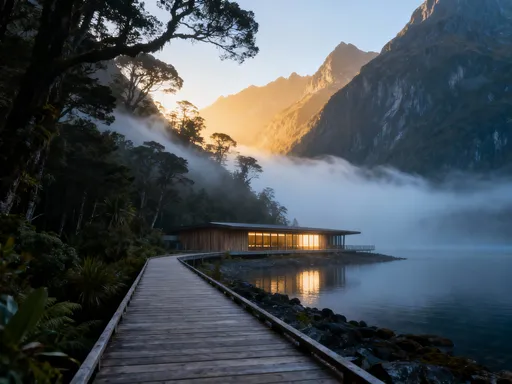
You Won’t Believe This Hidden Cityscape in Milford Sound
When you think of Milford Sound, towering cliffs and roaring waterfalls come to mind—but not cityscapes. Yet, nestled in this wild corner of New Zealand’s Fiordland, there’s a quiet, unexpected charm in the small human touches against nature’s grandeur. I was stunned by how the visitor center, walking paths, and dockside structures blend seamlessly into the landscape. This isn’t urban sprawl—it’s a minimalist human footprint that enhances, not disrupts, the wilderness. Let me take you through this niche perspective.
Reimagining Cityscape: Not Skyscrapers, But Harmony
The word "cityscape" often conjures images of skylines, traffic, and bustling streets. But in Milford Sound, the concept takes on a gentler, more poetic meaning. Here, the cityscape is not defined by density or scale, but by harmony—how human presence can be felt without being seen. The subtle design of walkways, shelters, and viewing platforms forms a quiet network that supports visitors while remaining in deep conversation with the natural world. This redefinition invites travelers to expand their understanding of what built environments can be: not always dominant, but sometimes deferential.
Imagine standing at the edge of the fiord at sunrise, the first golden light touching the cedar shingles of the visitor center. The building appears almost organic, as though it grew from the same earth as the surrounding ferns and moss-covered rocks. There are no glass towers, no neon signs—just carefully placed structures that serve a purpose without demanding attention. The lighting is soft and low, designed to guide rather than dazzle. At dusk, warm glows emerge from window frames, reflecting off damp wooden railings, creating a sense of sanctuary without breaking the silence of the wilderness.
This kind of cityscape is not accidental. It is the result of deliberate planning and a deep respect for place. Architects and planners have worked closely with conservationists to ensure that every element—from the angle of a roof to the color of a door—complements the environment rather than competes with it. The effect is profound: visitors feel welcomed and supported, yet never lose the sensation of being immersed in raw, untamed nature. It’s a delicate balance, one that challenges the assumption that infrastructure must be intrusive to be functional.
What makes this approach revolutionary is its scalability. While Milford Sound is remote, the philosophy behind its design can inspire urban planning far beyond Fiordland. Imagine cities where buildings breathe with their surroundings, where light respects the night sky, and where pathways invite contemplation instead of haste. Milford Sound offers a quiet manifesto for a different kind of development—one where the goal is not to conquer landscape, but to belong within it.
Why Milford Sound? The Allure of Controlled Access
Milford Sound’s magic begins long before you arrive. The journey itself is part of the experience—a long drive through the Homer Tunnel, flanked by sheer rock faces and sudden waterfalls cascading down after rain. Or perhaps you arrive by small plane, gliding over snow-dusted peaks before touching down on the water. These routes are not merely logistical; they are transformative. They strip away the noise of daily life and recalibrate your expectations. By the time you reach the fiord, you’re no longer a tourist rushing from one sight to the next—you’re a guest in a place that demands presence and patience.
This controlled access is intentional. Unlike many popular destinations that expand roads, build airports, or encourage mass tourism, Milford Sound remains deliberately difficult to reach. There are no highways, no shopping malls, no endless rows of hotels. The infrastructure is minimal, carefully managed, and designed to preserve the integrity of the landscape. As a result, the few buildings clustered at the edge of the water feel less like a settlement and more like a temporary gathering—something temporary, respectful, and fleeting.
The contrast between the wild journey and the calm arrival is striking. Emerging from the tunnel into the valley, you see the first signs of human presence: a dock, a low-slung building, a pathway winding toward the water. But these elements don’t diminish the sense of awe—they frame it. They offer vantage points, shelter, and orientation without overwhelming the natural drama. This balance between isolation and service is rare, and it’s one of the reasons Milford Sound continues to feel sacred, even as visitor numbers grow.
Moreover, the difficulty of access naturally limits the number of people who can visit each day. This helps prevent overcrowding and allows for a more intimate experience. You might share a boat cruise with others, but you’ll also have moments—standing alone on a boardwalk, watching rain fall across the fiord—where the world feels entirely yours. In an age of instant gratification and constant connectivity, Milford Sound reminds us that some places are worth the effort. The journey shapes the memory, and the destination rewards those who arrive with reverence.
The Architecture of Discretion: Buildings That Disappear
At first glance, the structures in Milford Sound seem almost invisible. They don’t tower over the landscape; instead, they nestle into it. The visitor center, boat terminals, and nearby lodges are built with low profiles, sloping roofs, and natural materials like timber and stone. Their colors echo the surrounding environment—muted greens, earthy browns, and soft grays that blend with mist and shadow. This architectural discretion is not about hiding, but about listening. Each building responds to the land, adapting to its contours and climate rather than imposing a foreign shape upon it.
The visitor center is a prime example. Constructed with sustainably harvested wood and featuring a green roof planted with native vegetation, it appears as though it could have emerged from the forest floor. Inside, large windows frame panoramic views of the fiord, turning the landscape into a living exhibit. The layout encourages slow movement—visitors naturally pause, look out, and absorb. There are no flashing screens or loud announcements, just quiet spaces for reflection and information presented in a calm, unobtrusive way.
Similarly, the boat terminals are designed for function without fanfare. They provide shelter, seating, and safe access to the water, but they do so with simplicity. Railings are made of dark-stained wood, posts are spaced to minimize visual clutter, and roofs are angled to shed rain while preserving sightlines. Even the lighting is recessed and directional, illuminating pathways without spilling into the sky or disturbing nocturnal wildlife.
This philosophy reflects New Zealand’s broader commitment to conservation and sustainability. The country’s Department of Conservation (DOC) plays a central role in overseeing development in protected areas, ensuring that every structure serves a clear purpose and adheres to strict environmental standards. In Milford Sound, architecture is not a statement of human achievement, but a gesture of humility. It says: we are here, but we do not own this place. We are passing through, and we will leave as little trace as possible.
Walking the Edge: Pathways as Urban Threads
If cities have streets, then Milford Sound has boardwalks. These wooden pathways form the connective tissue of the micro-cityscape, linking the visitor center, viewing platforms, docks, and lodges. They are narrow, gently sloping, and built with precision to protect the fragile alpine soil beneath. As you walk, the planks creak softly underfoot, a quiet rhythm that matches the pace of the place. Handrails are low and unobtrusive, offering safety without obstructing views. Signage is minimal—just enough to guide, not enough to distract.
Walking these paths at dawn is a particularly moving experience. The air is cool and still, the fiord shrouded in mist. Sunlight filters through the canopy, dappling the wood with shifting patterns. Every few steps, the view opens—a sudden glimpse of Mitre Peak rising from the water, a waterfall tumbling down a distant cliff, a seal basking on a rock below. The path doesn’t reveal everything at once; it unfolds like a story, with moments of surprise and quiet revelation.
These trails are also designed with accessibility in mind. Gentle gradients, non-slip surfaces, and resting points make them usable for a wide range of visitors, including those with mobility challenges. Yet, they never feel institutional or overly engineered. The craftsmanship is evident in the way the wood is joined, the way steps follow the natural slope of the land, the way benches are placed to face the most breathtaking vistas. It’s a reminder that thoughtful design can be both inclusive and beautiful.
In this way, the pathways serve as more than just routes from one place to another—they are part of the experience itself. They invite slowness, observation, and connection. They teach visitors how to move through nature with care, reinforcing the idea that every step matters. In a world where travel often means rushing from destination to destination, Milford Sound’s boardwalks offer a different rhythm—one that aligns with the pulse of the land.
Light After Dark: When the Fjord Gets Cozy
Most visitors leave Milford Sound before sunset, missing one of its most intimate transformations. As darkness falls, the fiord takes on a new character. The towering cliffs fade into silhouette, the water becomes a mirror of the sky, and the few lights from buildings and pathways begin to glow. This is when the hidden cityscape softly reveals itself—not with brilliance, but with warmth. The effect is not urban, but domestic—a sense of shelter in the midst of wilderness.
Lodges and guesthouses emit a golden light from their windows, their reflections shimmering on wet walkways. Solar-powered lamps line the edges of boardwalks, casting soft pools of illumination that guide without glare. There’s no street lighting, no floodlights—just enough light to move safely, to read a book on a porch, or to sip tea while listening to the distant sound of falling water. The absence of light pollution means stars soon emerge, filling the sky above the fiord with a brilliance rarely seen in cities.
This shift from awe to intimacy is profound. During the day, the landscape overwhelms the senses—its scale, its power, its drama. At night, it invites closeness. You notice smaller details: the texture of bark on a nearby tree, the sound of rain on a roof, the quiet conversation of fellow travelers. The built environment supports this transition perfectly. It doesn’t try to compete with nature; instead, it creates pockets of comfort where people can rest, reflect, and reconnect.
Staying overnight also changes the rhythm of travel. Without the pressure to catch a ferry or shuttle, you can linger. You can wake before dawn, walk the empty paths, and watch the first light return to the peaks. You can experience the fiord in different moods—windy, calm, rainy, clear—and begin to understand its deeper character. The nighttime cityscape, subtle as it is, makes this possible. It proves that even in the most remote places, human presence can be a source of warmth, not disruption.
Behind the Scenes: How Services Sustain the Illusion
The beauty of Milford Sound’s built environment lies in its invisibility. Visitors enjoy clean facilities, reliable power, and safe access without ever seeing the systems that make it possible. But behind the scenes, a complex network of services ensures that the illusion of simplicity is sustained. Waste is carefully managed, water is collected and treated, and energy is generated with minimal environmental impact. These operations are not flashy, but they are essential to preserving the very qualities that make the place special.
Power, for instance, comes largely from renewable sources. Solar panels are integrated into building designs, often placed on roofs or in nearby clearings where they don’t disrupt views. Some facilities use hydroelectric micro-grids, harnessing the constant flow of mountain streams. Backup generators run on biodiesel and are used only when necessary. The goal is energy independence with zero emissions—a challenge in such a remote location, but one that operators have met with innovation and determination.
Water management is equally sophisticated. Rainwater is collected from roofs and stored in underground tanks. It’s then filtered and treated for drinking, cooking, and washing. Wastewater is processed through advanced septic systems that prevent contamination of the fiord. All of this happens out of sight, beneath wooden decks and behind green walls, ensuring that the natural environment remains pristine.
Staff logistics are another quiet marvel. Many workers live on-site in modest accommodations, rotating in and out on a schedule that minimizes traffic and environmental impact. Supplies are brought in by boat or truck, carefully planned to reduce waste and excess. Even trash is transported out by the same means, sorted and recycled whenever possible. Every decision is guided by a single principle: leave no trace.
This hidden efficiency is not just practical—it’s philosophical. It reflects a deep commitment to stewardship, a belief that protecting nature is not separate from providing service, but central to it. In Milford Sound, infrastructure doesn’t serve people at the expense of the environment; it serves both. The result is a destination that feels untouched, even as it welcomes thousands of visitors each year.
Traveler’s Guide: Experiencing the Cityscape Mindfully
To truly appreciate Milford Sound’s hidden cityscape, you must slow down. This is not a place to rush through. The most meaningful experiences come to those who stay overnight, explore at quiet hours, and pay attention to details. Begin by choosing accommodation that aligns with the ethos of the place—eco-lodges, DOC huts, or small guesthouses that prioritize sustainability. Arrive early or late in the day to avoid crowds and witness the landscape in softer light.
Bring clothing that layers well—weather in Fiordland changes quickly, and rain is common. Waterproof boots, a warm jacket, and a hat will serve you better than fashion. Pack a notebook or journal to record your observations. Notice the materials used in buildings, the way light falls on pathways, the sounds (or lack thereof) at different times of day. These small details form the fabric of the cityscape.
Explore on foot. Walk the boardwalks slowly, pause at overlooks, and take time to sit and simply be. Visit the visitor center not just for information, but to study its design—how it opens to the view, how it uses natural light, how it feels inside. If you take a boat cruise, look back at the shore and observe how the structures sit in the landscape. From the water, their humility becomes even more apparent.
Respect boundaries. Stay on marked paths, follow all guidelines, and avoid touching or disturbing any part of the environment. Remember that every choice you make—where you step, what you leave behind, how loudly you speak—affects the experience of others and the health of the ecosystem. Responsible tourism isn’t a slogan here; it’s a necessity.
Finally, carry this mindset beyond Milford Sound. Let this place inspire a different way of traveling—one that values restraint, observes deeply, and leaves gently. The lessons of this hidden cityscape extend far beyond Fiordland, offering a vision of how humans and nature can coexist with grace.
Milford Sound’s true magic lies not just in its wild peaks and waterfalls, but in how thoughtfully humans have touched the land—just enough to welcome you, not enough to spoil it. This niche cityscape is a lesson in restraint, a whisper in a world of shouts. It invites us to travel deeper, see differently, and leave lighter. The future of travel might not be bigger cities—but smaller footprints.