You Won’t Believe These Hidden Viewpoints in Valparaiso
Valparaiso isn’t just a city of colorful houses and winding alleys—it’s a treasure trove of breathtaking perspectives hiding in plain sight. I wandered its hills with no map, chasing light and gradients, and stumbled upon viewpoints most travelers miss. Each one offered something raw and real: the Pacific stretching endlessly, rooftops cascading like paint spills, and quiet moments where time slowed down. These aren’t just photo spots—they’re soul-soakers. In a place where every turn reveals a new layer of texture and tone, the true magic lies not in the postcard views, but in the unscripted vantage points that feel like secrets whispered from the city itself. This is a guide to those moments, those places, and the quiet grace of seeing Valparaiso not as a destination, but as a living, breathing work of art.
The Magic of Valparaiso’s Vertical Soul
Valparaiso is a city built on ascent. Its soul is vertical, shaped by 42 cerros—steep, undulating hills—that rise sharply from the Pacific coast. Unlike flat urban landscapes where movement is linear and predictable, Valparaiso demands engagement. To experience it fully is to climb, to wind through narrow staircases, to surrender to gravity and effort. Each hill becomes a world unto itself, with its own rhythm, community, and perspective. This topography does more than define the city’s layout—it transforms how one sees, feels, and remembers it. Elevation here is not just physical; it’s emotional. The act of climbing becomes a ritual, a slow unfolding of beauty that reveals itself only to those willing to step off the main streets and upward into the unknown.
The city’s famed ascensores—wooden funicular elevators that have been creaking up and down the hills since the late 19th century—serve as both practical transport and poetic metaphors. These historic lifts, many of which are designated national monuments, offer a gentle alternative to the hundreds of steps that connect neighborhoods. Yet even they require a small journey: a short walk from the port, a wait at the base, and a slow, swaying climb through residential alleys. The movement itself—ascending gradually, watching the city unfold beneath you—is part of the experience. It’s in these moments, suspended between street level and skyline, that Valparaiso begins to reveal its layered beauty.
What makes Valparaiso’s viewpoints so powerful is that they are never just about the destination. The journey matters as much as the view. Each staircase, each winding path, each pause to catch your breath offers a new frame—a glimpse of a painted wall, a courtyard bursting with bougainvillea, a stray cat sunning on a tiled roof. The city rewards slowness. It asks you to notice the way light shifts across corrugated metal roofs, how laundry flutters like flags in the coastal wind, how the scent of eucalyptus drifts down from higher elevations. In this way, every climb becomes a meditation, every viewpoint a moment of arrival—not just to a panorama, but to presence.
Cerro Artillero – A Local’s Secret Above the Fog
Nestled just behind the more famous Cerro Alegre, Cerro Artillero remains one of Valparaiso’s best-kept secrets. While guidebooks overflow with references to Paseo Atkinson and Mirador Gervasoni, this quieter hilltop offers a vantage point where daily life and dramatic scenery coexist. It’s not polished. There are no souvenir stalls, no guided tours, no crowds jostling for the perfect selfie. Instead, you’ll find clotheslines strung between homes, flower pots lining stone steps, and elderly residents sipping tea on weathered benches. This is a place where the city breathes, where the view is shared not for spectacle, but as part of life.
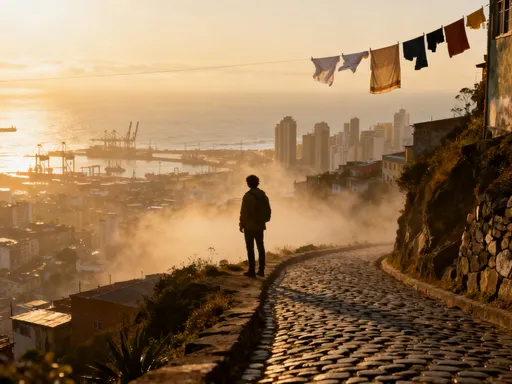
The magic of Cerro Artillero often arrives in fragments. On foggy mornings, the bay disappears behind a veil of mist, and the world feels suspended. Then, without warning, the clouds part—just briefly—and the ocean reappears, a vast expanse of silver-blue stretching to the horizon. Fishing boats become visible, tiny specks moving slowly across the water. The port comes into focus, with its cranes and containers arranged like pieces on a giant board. These fleeting moments feel earned, not given. They reward patience and presence. Photographers may come for the light, but those who linger stay for the stillness.
The best time to visit is late afternoon, when the sun begins to dip and the fog lifts with greater consistency. Weekday mornings also offer a rare intimacy—few tourists, more locals, and a quiet that allows you to hear the distant hum of the city below. To reach Cerro Artillero, take the Ascensor Artillería from the lower part of town. This historic lift, with its faded green carriage and hand-operated doors, climbs steeply through a narrow residential corridor. At the top, follow the signs toward the small open plaza. From there, a series of stone steps leads to the highest point, where a simple metal railing marks the edge of the view. There’s no grand monument, no engraved plaque—just an unobstructed gaze across the bay, and the sense of having discovered something real.
Paseo Gervasoni – Postcard Perfection with a Story
If Valparaiso has a signature viewpoint, it is Paseo Gervasoni on Cerro Concepción. This elegant promenade, framed by ornate iron railings and cobblestone paths, offers one of the most photographed panoramas in the city. From this vantage, the port unfolds like a living diorama—ships docked in orderly rows, the curve of the coastline, and the endless stretch of the Pacific beyond. The rooftops below cascade in a chaotic harmony of red, blue, and yellow, as if spilled from a painter’s palette. Yet what makes Paseo Gervasoni more than just a pretty picture is its history—a story embedded in its design and details.
Built in the late 19th century, Paseo Gervasoni reflects the influence of European immigrants who helped shape Valparaiso’s architectural identity. The ironwork, reminiscent of Parisian balconies, was imported from England and installed by skilled local craftsmen. The walkway itself was designed not just for views, but for leisure—a place where families could stroll, couples could linger, and the city’s growing middle class could enjoy the sea breeze in elegance. Today, it remains a symbol of that era’s optimism and craftsmanship. The preservation of its original features speaks to the city’s commitment to honoring its past, even as it evolves.
For photographers, the ideal time to visit is during golden hour, when the late afternoon sun bathes the port in warm, amber light. The shadows lengthen across the hills, and the water shimmers with gold. A wide-angle lens captures the full sweep of the panorama, while a telephoto can isolate details—fishermen unloading their catch, seagulls circling above the docks, or a sailboat cutting through the waves. Just steps from the viewpoint, small cafés offer empanadas, fresh juice, and strong Chilean coffee. Sitting at an outdoor table, watching the light change, becomes an experience in itself. While Paseo Gervasoni is undeniably popular, its beauty is not diminished by the crowds. There is enough space, enough detail, enough soul to go around.
Mirador Portales – Where the City Comes Alive
Rising above Cerro Alegre, Mirador Portales offers a different kind of energy—one that pulses with life, music, and movement. Unlike quieter viewpoints where silence amplifies the vastness of the sea, this mirador thrives on human connection. Street performers often set up here, strumming guitars, playing Andean flutes, or dancing folkloric routines as the sun sets. Travelers gather on stone benches, sharing snacks and stories. Local artists display paintings for sale. The air fills with laughter, the smell of grilled meat, and the occasional burst of applause. This is not a place to escape the world; it’s a place to celebrate being in it.
The view itself is spectacular. From Mirador Portales, the city spreads out in a complex tapestry of rooftops, church domes, radio antennas, and winding streets. The port lies directly ahead, with cargo ships moored beside smaller fishing vessels. In the distance, the coastal range rises like a soft blue wall. The perspective is wide, almost cinematic, offering a sense of both intimacy and scale. You can see individual windows and flower boxes, yet also grasp the city’s sprawling, organic form. It’s a reminder that Valparaiso is not a museum—it’s a working port, a living community, a place where history and modernity coexist.
Access is easy via the Ascensor Espíritu Santo, one of the city’s most reliable funiculars. From the top station, a short walk leads to the mirador, which is well-marked and equipped with informational plaques. But the journey itself is part of the experience. The streets leading to Mirador Portales are lined with vibrant murals—some political, some whimsical, all deeply expressive. These artworks tell stories of resistance, identity, and hope, adding layers to the visual feast. Visitors are encouraged to walk slowly, to look up as much as out, and to let the city’s creative spirit guide them. Evening visits are especially rewarding, as the city lights begin to twinkle and the sky shifts through shades of pink and violet.
Cerro Calvario – Raw Beauty, No Filters Needed
For those seeking solitude and unvarnished beauty, Cerro Calvario offers a powerful alternative to the more frequented viewpoints. Located near Plaza Justicia, this hill feels wilder, less curated. The paths are uneven, the vegetation untamed, and the structures around the mirador show signs of age—peeling paint, cracked stonework, ivy climbing over abandoned walls. There is no café, no gift shop, no handrails. Just a simple stone ledge where you can sit and watch the world unfold.
And what a world it is. From Cerro Calvario, the ocean dominates the horizon, stretching endlessly under shifting skies. Fishing boats move in quiet patterns, their wakes dissolving into the waves. Seabirds glide on coastal thermals, calling to one another in sharp, rhythmic cries. The air is cooler here, scented with salt and damp earth. On clear days, you can see the distant silhouette of Isla Negra, the former home of poet Pablo Neruda. There’s a poetic stillness to this place—a sense that time slows, that the noise of daily life fades into the background.
This is not a viewpoint for those who need comfort or convenience. The climb requires sturdy shoes and a willingness to navigate uneven terrain. Some sections lack clear signage, and the path can be slippery after rain. But for the patient traveler, the reward is authenticity. There are no crowds, no performances, no distractions. Just the view, the wind, and the quiet rhythm of the sea. Cerro Calvario is for those who understand that beauty does not always need to be polished to be profound. Sometimes, the most moving experiences come from places that feel untouched, unclaimed, and real.
Urban Exploration Meets Mindful Travel
Seeking out Valparaiso’s viewpoints is more than a sightseeing checklist—it’s an act of mindful travel. In a world where tourism often means rushing from one landmark to the next, Valparaiso invites a different pace. Each climb, each pause, each moment of stillness becomes a form of attention. The physical effort of ascending the hills mirrors an internal journey—one of slowing down, of becoming present, of noticing what is often overlooked. In this way, the city teaches a quiet lesson: that the best views are not always the most famous, but the ones we arrive at with awareness.
There is a rhythm to wandering Valparaiso without a rigid plan. You begin to recognize patterns—the way certain colors repeat across different hills, how music drifts from open windows, how the scent of baking bread appears unexpectedly around corners. You start to see the city not as a collection of attractions, but as a living organism, breathing and evolving. The viewpoints, then, are not endpoints, but moments of reflection. They are places to pause and ask: What am I carrying? What am I releasing? How am I seeing?
This kind of travel does not require special skills or equipment. It only asks for curiosity, respect, and a willingness to be surprised. When you let go of the need to capture the perfect photo or visit every recommended spot, you open yourself to the unexpected—the elderly woman who offers you a slice of orange on a hot day, the child who waves from a balcony, the sudden rainbow that appears after a brief shower. These are the moments that stay with you, long after the trip ends. Valparaiso, in its chaotic beauty, becomes a mirror—reflecting not just the landscape, but your own capacity to see deeply.
How to Experience the Viewpoints Like a True Wanderer
To truly experience Valparaiso’s viewpoints, preparation matters—but not in the way you might think. Forget elaborate itineraries or timed entries. Instead, focus on the essentials: wear comfortable walking shoes with good grip, as the hills are steep and the cobblestones can be slippery. Carry a refillable water bottle, especially in summer, when the sun beats down on exposed paths. A lightweight jacket or shawl is wise, even on warm days—the coastal breeze can be surprisingly cool at higher elevations.
Start early in the morning, ideally between 7:00 and 9:00 a.m. The light is soft, the air is fresh, and the streets are quiet. You’ll have viewpoints like Paseo Gervasoni and Mirador Portales almost to yourself. This is also the best time to see residents beginning their day—sweeping doorsteps, hanging laundry, chatting over fences. These small human moments add depth to the visual experience. If you plan to visit multiple hills, allow at least three to four hours, with time to rest and absorb what you’ve seen.
Nourishment is part of the journey. Along the way, look for small empanada stands tucked into corners—try the pino, filled with seasoned beef, onion, and a green olive. Fresh fruit juices, especially lúcuma or chirimoya, are sold at neighborhood markets. A stop at a local café for a café con leche and a medialuna (Chilean croissant) can turn a simple break into a cultural moment. These small pleasures ground the experience, making it not just visual, but sensory and emotional.
Most importantly, travel with respect. Remember that these hills are not tourist zones—they are neighborhoods where people live, work, and raise families. Avoid loud conversations, do not enter private properties, and be mindful when photographing homes or residents. Leave no trace. Take only memories, and perhaps a few photographs taken with kindness. The beauty of Valparaiso is not something to be consumed, but to be shared—with gratitude, with humility, and with wonder.
Valparaiso’s viewpoints are more than scenic stops—they’re invitations to see deeper, climb higher, and feel more. Each offers not just a view of the city, but a mirror to your own journey. The real beauty lies not in capturing the perfect photo, but in letting the moment capture you.